

Capturing Populist Movements
under construction still
I never voted until 2024, when I voted for Trump.
For most of my life I didn't think about politics at all. It wasn't in my personality, and it never interested me, because I always assumed the system was rigged. Watching Obama walk back his promises almost as soon as he got into office, and watching the horrific results of the foreign wars, didn't exactly change my mind.
2024 felt different. Trump was loud about ending those wars, and for a while it looked like he was actually trying, like in that struggle session with Zelensky on camera where he told him he didn't have the cards. I was also very much behind RFK Jr. and the MAHA movement.
I'm writing this because of what happened after that. And the best way I've found to explain it is a bike race.
How a Peloton Works
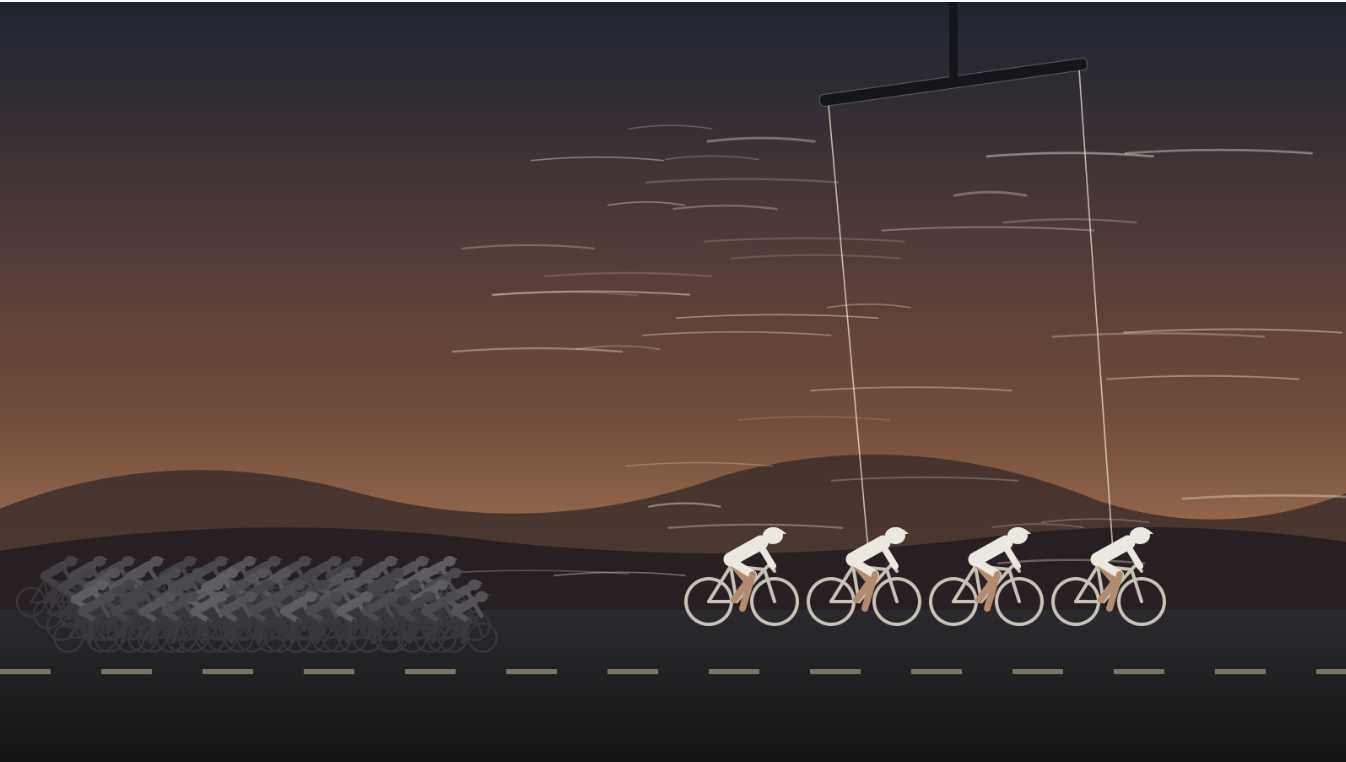
If you've ever watched a road race, the Tour de France or just a local race, you've seen the peloton, the big pack of riders moving together.
They ride in a pack for a reason. The rider at the front is punching a hole in the wind, and everyone tucked in behind them is drafting, saving a huge amount of energy. The pack as a whole is much faster and more efficient than any single rider.
In a long race the field usually splits. There's a lead group up front with the strongest riders in the best position. Behind them are the chase groups, riders who couldn't hang on and are trying to get back.
And every so often, a few riders jump off the front and try to get away from everybody. That's the breakaway.
Breakaways Run on Alliances
You can't break away alone, at least not for long. A solo rider out front does all the work while the pack behind shares it, and the pack will almost always reel them back in.
So a breakaway only works if the riders in it cooperate. They take turns pulling at the front so no one burns out. The strange part is who you're cooperating with. The other riders in the break are your competitors. You need your rivals to help you get away, and at the finish you'll try to beat them.
It's a temporary alliance, and it's fragile. All it takes is one rider who sandbags, sitting at the back of the break, taking a free ride, refusing to pull. The rhythm falls apart and the pack closes the gap.
In real racing, teams do this on purpose. If a team's leader is back in the peloton, they'll put a rider in the breakaway just to sit on it and slow it down.
The difference is that in a bike race, you know who's doing it.
Politics Doesn't Have Jerseys
Cycling is structured. Every rider wears a team jersey, and every team has a set number of riders. When a breakaway forms, everybody can see who's in it and who they ride for.
Politics doesn't work that way. There are no jerseys. When a movement breaks away from the pack, nobody knows for sure which team anyone in the group is really riding for. The person pulling hardest next to you might be on your side. They might also be there to make sure you never reach the finish.
And unlike a bike race, the wind isn't just weather. There are outside forces that can create headwind on purpose, through lawfare and coordinated media attacks, so that every bit of progress costs the movement more energy than it should.
Wear a breakaway down long enough, and it starts accepting help from anyone willing to take a turn at the front.
Why Capture a Movement Instead of Killing It?
If you're in power, you might think the goal would be to crush a movement outright. I don't think that's the game. A movement is far too valuable to waste.
Take MAGA. Even after the movement was compromised, a core group of loyalists stuck around anyway, the true believers. Whoever is running the Trump administration now has, in effect, secured a portion of the population as something close to fanatics. That's an asset.
At the same time, the people who were genuinely America First got thoroughly demoralized. Watching the project they believed in get taken over left a lot of them with distrust, resentment, or just apathy.
So capturing a movement does two things at once. It keeps the most loyal riders in the pack, and it takes the fight out of everyone who might have started the next breakaway.
The Carrot and the Stick
In our current political and media environment, I think the name of the game is taking over movements.
I'm using MAGA and MAHA because they're the most recent examples, but I watched the same thing happen to Bernie Sanders and Andrew Yang. I believe the pattern is the same.
There's a carrot and a stick. The stick is the headwind: the lawsuits and the media attacks. The carrot is relief. The extremely powerful, think banks and investment firms, will try to subvert a movement by creating dependencies. Maybe that's getting lawsuits dropped. Maybe it's a sponsor, think Larry Ellison or Peter Thiel types, showing up as a backer of sorts.
Either way, the movement gets a rider who's willing to pull. It just doesn't get to know which team that rider is on.
The Race Was Never Fair
It's obvious to me that there is a general playbook being used when it comes to populist movements
- get as many people onboard to begin with.
It seems to me that populist movements are a feature of the system, meant to lure in unwitting normies and create an illusion of democracy. And with an illusion of democracy, responsibility can be placed at the feet of the voters, or of the politicians who aren't around very long. It works as a kind of diffusion of responsibility, while the people making the real decisions, whether it's wars or inflation, go unnoticed.
Recognizing the Game
Assuming I'm on to something, and I think I am, then if enough people catch on, the populist capture game loses its power in two ways.
First, it loses its power to demoralize. I think demoralization is their number one tool when it comes to controlling policy. If people are demoralized and remove themselves from the political process altogether, or just blame their neighbors for their problems, that's a victory for the status quo.
Second, recognizing the game can have the opposite effect. If enough people realize what's happening while it's happening, then instead of being disappointed and upset, they'll call it out for what it is and spread awareness to everyone else.

We have "cartesian blinders being put on us so that we are trying to make sense out of scraps of information and hints." - @bretweinstein
WEINSTEIN: I mean, even if you have your villains who are engaged in the behavior that motivated this war in Iran, even if that's the story, presumably most of the people in the path of these ferocious bombings that he is describing are not deserving of going back to the Stone Age.
In fact, I distinctly remember him telling us that part of what we were up to was liberating the people of Iran from their tyrannical regime.
So if it's the tyrannical regime that justifies the ferocious bombing, then it's a tragedy that other people are going to be sent back to the Stone Ages with them. Right?
HEYING: It's it's not a narrative. It's an incoherent set of talking points.
WEINSTEIN: Yeah, it's a kind of cheerleading that is completely inappropriate from the perspective of the president.
Bret Weinstein discusses the Trump administrations "back to the stone age" recent remarks in the latest episode of The Evolutionary Lens, Episode 320 "Are we back in the stone age?" on DarkHorse.
Bret Weinstein explains, "If you stop businesses from starting here, and if you drive people so that they move elsewhere—even though it's difficult to do—then the point is the tax base dries up, which then forces you to become even more predatory for the people who stayed.
And that's really the thing, right? They're setting themselves up so that they have to go after more and more people, because the people who are starting new businesses are not going to do it here."
I tried the letter by Brian Ward to Senator Moody in my AI (alter.systems.AI) this is what produced.
What This Letter Is
A formal complaint letter from Brian Ward (Fort Walton Beach, FL) to Senator Ashley Moody, dated October 26, 2026. He positions himself as a regulatory-affairs expert who has consulted on 30+ federal and state cases involving coerced medical experimentation.
Core thesis: A coordinated effort by the FDA, federal judges, state governors, and agencies (HHS, CDC) has pushed the country into what he calls a "post-constitutional form of government" — specifically:
FDA Rule 21 C.F.R. § 50.22 (finalized January 2024) — he claims it permits covert, consent-free human experimentation, biometric data collection, and "shadow files" on citizens, including newborns.
Judicial nullification of due process — 40+ federal judges dismissed 16 lawsuits under Rule 12(b)(6), and the Ninth Circuit (in Brock v. City of Bellingham, Petition No. 26-268) held that governments can force licensed professionals to take investigational...
A couple weeks ago @bretweinstein pondered if dogs actually like to chase balls or if dogs enjoy watching humans play chase with them. Lola submits one data point, herself. She enjoys tossing balls to herself, and will while no one is watching. I'm trying to get a better video, she will also grab a tennis ball by it's fluf and launch it straight up, like a lacrosse player throwing a ball. She'll drop them down stairs, drop them off the ottoman, or any other high elevation and chase them. She's also developed a sorta soccer style to nudge them back on hardwood floors. So with test subject Lola, the answer is clearly "dogs love chasing balls".