


Boom Bust Cycles of Influence
How fiat audiences capture influencers
What does a massive propaganda or influence campaign actually look like? I think if you want to understand how online warfare takes place, the best model we have is the banking system.
When it comes to the internet, attention is the coin of the realm, and there’s nothing more sought after than an influencer who commands a lot of it. And just like fiat currency, attention can be used to artificially inflate audiences and engagment, essentially astroturfing (whether wittingly or unwittingly) content creators.
Tactic #1: The boom bust cycle
I think bots work as the fiat currency of the online world. Whoever controls the bots can choose to inflate an audience the same way banks inflates the money supply, by creating something out of nothing. To the influencer, it might look like natural growth along with real people too, or perhaps they are incensitivized not to notice (or care). It’s basically the housing bubble all over again.
What I think happened to Scott Adams is that a good portion of his audience was fiat that very much seemed like real people. They would flood the chats, making it difficult for people to communicate with him (that was my experience), thus isolating him. These bots would likely superchat regularly too, which perhaps convince some to leave other forms of stable income in pursuit of a full-time content creator career. That’s the trap, becoming dependent on that revenue, being dependant on your audience.
And of course, when you can create a boom, you can just as easily cause a bust. Think of it as audience capture. If the content creator starts saying the wrong things (e.g. questioning vaccine safety), all of a sudden their chat, superchats, and their engagement start to really suffer, thus causing a tremendous amount of leverage that could easily escalate into forms of coordinated attacks from media networks (e.g. Aaron Rodgers).
I suspect that’s what happened to Scott when he started to experiment with ivermectin and fenbendazole for his prostate cancer, which ultimately caused him to publicly scorn the protocol altogether, including Dr. William Makis. I’ve seen similar patterns with others on COVID related topics.
Tactic #2: The plant
The second tactic uses the exact same machinery as the first, just pointed in a different direction. Instead of inflating a normal influencer type, you astroturf someone who’s already on the team and inflate their reputation. I very much see people like Nick Fuentes, Alex Jones, and more recently Baron Coleman this way. Essentially, not only are they heavily astroturfed by bot accounts and superchats, but they’re also fed inside information, giving them the appearance of competency and letting them outcompete those who don’t have the same advantages. There often times able to put out more clips and become more viral, especially when using clip farms.
Tactic #3: Nudging and chaos
Then there are the low-level attacks. Not every operation needs to capture someone. Sometimes the goal is just to nudge, using bots to steer conversations, whether by distracting with other topics or shaming people who bring up certain topics. This has happened to me where a quiet chat room on twitch will suddenly roar to life if I say words like "Charlie Kirk". Other times, bots become chaos agents of sorts: derailing chats, picking fights in the comments, mass-reporting videos, spamming the same talking points over and over until the real audience gets tired and leaves.
It’s a cheap tactic, but it works, and it’s often hard to see what’s happening. It gives content creators constant headaches, it can alienate their real audience, and over time it can push them into burnout. It also takes a psychological toll on regular people, making them insecure about their views after being attacked for them, or turning them off a content creator after one bad experience in the chat.
Tactic #4: Clip farming
I only learned about this recently, but clip farming is an industry built around creating virality. There are platforms where anyone can put out a bounty for clips made to their specifications (portray people and events a certain way), and, those financing influence operations, can operationalize an army of clippers will chop up streams and interviews and flood social media with them, getting paid by the view. There have been a lot of reporting on these clip farms being used to attack dissenters from main stream narratives.
What I think Can’t be Allowed
Once you start seeing these tactics, you realize the systems of control behind influence campaigns and propaganda have every incentive to go after people like Bret and Heather, who equip others to see through the various methods used for controlling narratives. Same with the old Jordan Peterson in the 2010s, when he was teaching about cautionary tales and evolutionary thinking through biblical stories and Disney movies. I noticed that he was getting non-religious people (me included) curious about biblical studies, and religious folk interested in evolution. That’s exactly the kind of influence that can’t be allowed to keep growing because that is a direct threat to the current systems of control within media.
One ring to rule them all
People who are curious about each other are a lot harder to divide, and division is the whole business model. By deploying the tactics above, and creating influencers who are beholden to an astroturfed audience, prevents genuine discourse, movements, and conversations from taking place.
I keep coming back to the rings of power from Lord of the Rings. Sauron didn’t conquer the kings of men by force. He gave them rings that gave them power, wealth, and long life. But every one of those rings was secretly bound to his, and the kings ended up as his servants, unbeknownst to the people they ruled.
Those who fund these vast influence and propaganda campaigns work the same way. The central bank of influence offers creators views, superchats, reach, and a career. All they have to do is let it happen, or be completely unaware that it’s happening. But anyone who tries to come up through the ranks naturally has an entire system of power and control to go against.


We have "cartesian blinders being put on us so that we are trying to make sense out of scraps of information and hints." - @bretweinstein
WEINSTEIN: I mean, even if you have your villains who are engaged in the behavior that motivated this war in Iran, even if that's the story, presumably most of the people in the path of these ferocious bombings that he is describing are not deserving of going back to the Stone Age.
In fact, I distinctly remember him telling us that part of what we were up to was liberating the people of Iran from their tyrannical regime.
So if it's the tyrannical regime that justifies the ferocious bombing, then it's a tragedy that other people are going to be sent back to the Stone Ages with them. Right?
HEYING: It's it's not a narrative. It's an incoherent set of talking points.
WEINSTEIN: Yeah, it's a kind of cheerleading that is completely inappropriate from the perspective of the president.
Bret Weinstein discusses the Trump administrations "back to the stone age" recent remarks in the latest episode of The Evolutionary Lens, Episode 320 "Are we back in the stone age?" on DarkHorse.
Bret Weinstein explains, "If you stop businesses from starting here, and if you drive people so that they move elsewhere—even though it's difficult to do—then the point is the tax base dries up, which then forces you to become even more predatory for the people who stayed.
And that's really the thing, right? They're setting themselves up so that they have to go after more and more people, because the people who are starting new businesses are not going to do it here."
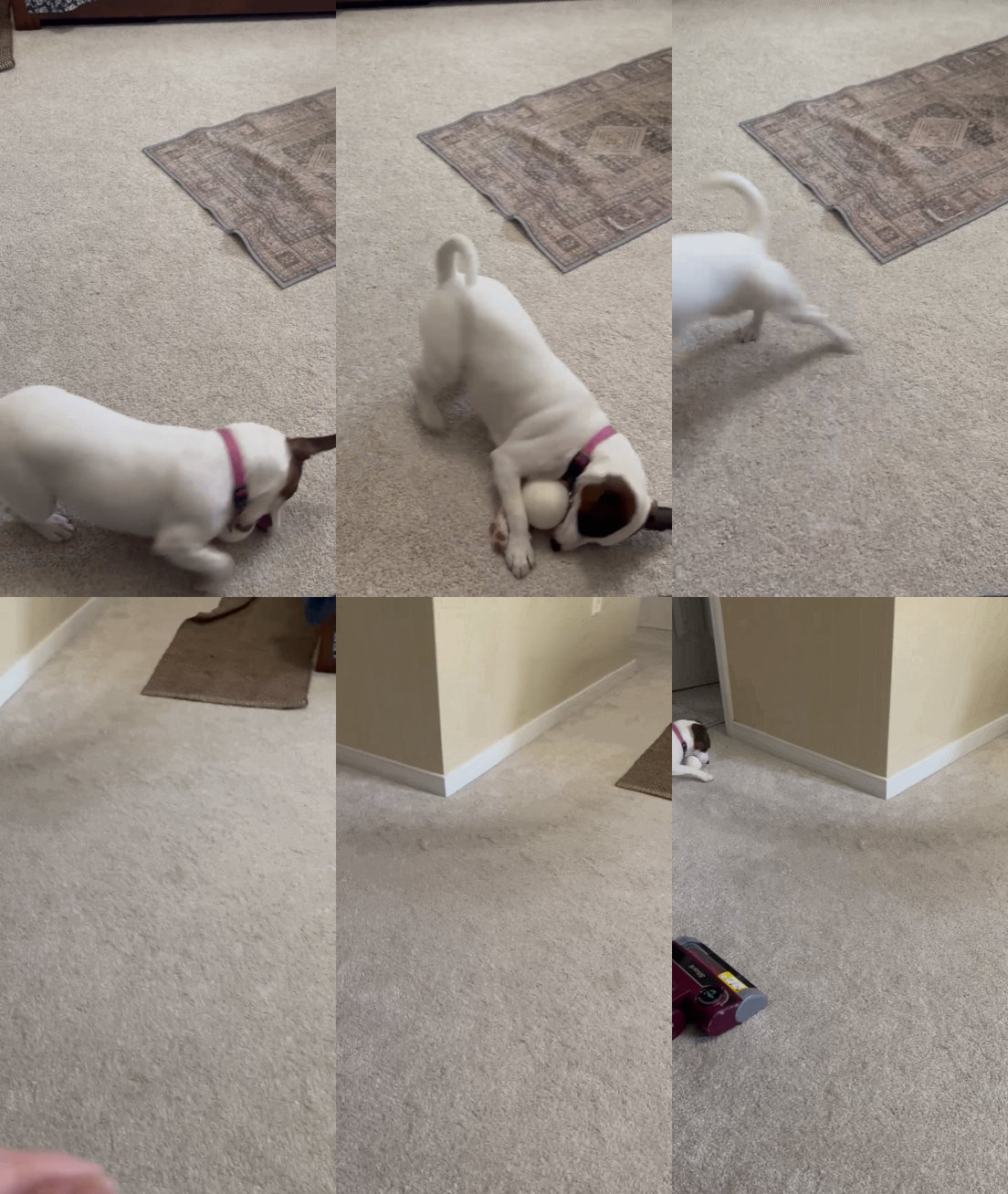
A couple weeks ago @bretweinstein pondered if dogs actually like to chase balls or if dogs enjoy watching humans play chase with them. Lola submits one data point, herself. She enjoys tossing balls to herself, and will while no one is watching. I'm trying to get a better video, she will also grab a tennis ball by it's fluf and launch it straight up, like a lacrosse player throwing a ball. She'll drop them down stairs, drop them off the ottoman, or any other high elevation and chase them. She's also developed a sorta soccer style to nudge them back on hardwood floors. So with test subject Lola, the answer is clearly "dogs love chasing balls".
Hi Folks, I saw the Alex Gibney documentary MUSK today and there is much to parse in it (timing, motivations, biases, flawed assumptions, lack of introspection on the part of the filmmakers, etc etc) but in one particular segment, Gibney claims that there were so many early covid victims in NYC that the City had to rent refrigeration trailers to store all the bodies. I had not heard that story and have zero trustworthy sources to investigate it.
Has anyone done an empirical analysis of that claim?
The Problem With Power
I'd like to see an evolutionary biology perspective on systems which embody power.
In my simplistic way I conceive of the problem as that of a niche in an ecosystem which has some small, at first, amount of power to control the ecosystem.
Continuing, simplistically, it seems natural to me that certain entities would be naturally inclined to occupy that niche and where the mechanisms exist increase the power.
To me that looks like a feedback loop where power begets power begets more power.
Of course the Federal Government was, theoretically, constrained from an unlimited acquisition of power, but here we are, thanks to The Supremes; beginning with the Marshall court and nailing the coffin closed with grossly incorrect interpretations of the 14th amendment.