

Bret and Heather, you advertise Xylitol products and spoke about its benefits several times. Did the recent Xylitol safety concerns come up on your radar? Will you please review and comment. Thank you.
Press-release by European Society of Cardiology (escardio.org) on Aug 26 this year: Xylitol may increase the risk of cardiovascular events.
www.escardio.org/news/press/press-releases/xylitol-may-increase-the-risk-of-cardiovascular-events
Dr. M. Witkowski did a presentation on that at the recent congress of that society. The abstract of the presentation can be found at esc365.escardio.org/esc-congress/sessions/20372-hungry-heart-nutrient-deficiencies-and-cardiovascular-disease
I also copied and pasted it below.
Also, these publications by the same doctor:
Witkowski M, Nemet I, Li XS, Wilcox J, Ferrell M, Alamri H, Gupta N, Wang Z, Tang WHW, Hazen SL. Xylitol is prothrombotic and associated with cardiovascular risk. Eur Heart J. 2024 Jul 12;45(27):2439-2452. doi: 10.1093/eurheartj/ehae244. PMID: 38842092; PMCID: PMC11492277
Witkowski M, Hazen SL. Xylitol and cardiovascular risks. Eur Heart J. 2025 Jul 14;46(27):2707-2708. doi: 10.1093/eurheartj/ehaf059. PMID: 40067656; PMCID: PMC13016789
Abstract of Witkowski's presentation at the EU Soc. of Cardiology congress:
The association of Xylitol and incident cardiovascular events: the CLSA and EPIC-Norfolk cohort studies
Authors
TM Zheng1 , ID Stewart2 , U Makhmudova3 , Y Chen4 , M Piezner5 , U Landmesser3 , S Zhou1 , N Wareham2 , M Witkowski3 , 1McGill University Health Centre, Quantitative Life Sciences - Montreal - Canada , 2University of Cambridge, Institute of Metabolic Science (IMS) Epidemiology - Cambridge - United Kingdom of Great Britain & Northern Ireland , 3German Heart Center Berlin - Berlin - Germany , 4Queen Mary University of London, Precision Healthcare University Research Institute - London - United Kingdom of Great Britain & Northern Ireland , 5Berlin Heart Institut, Computational Medicine - Berlin - Germany ,
Abstract
Background and aims:
Artificial sweeteners are generally regarded as safe by regulatory agencies and incorporated into processed foods in large amounts. Recent studies found that the low-calorie sweetener xylitol is associated with cardiovascular outcomes in high-risk populations and enhances thrombosis potential in vivo. The association of xylitol with cardiovascular event risk in the general population is unknown.
Methods:
Untargeted metabolomics data from two prospective observational studies across both North America and Europe (Canadian Longitudinal Study on Aging (CLSA), n=7,651; European Prospective Investigation into Cancer (EPIC)-Norfolk, n=10,059) were analyzed. Cox regression models adjusted for traditional cardiovascular risk factors were built to analyze the association between xylitol plasma concentrations and risk of incident major cardiovascular events (myocardial infarction, stroke or death, MACE).
Results:
A total of 17,710 participants from the two cohorts with a mean age of 60.9 years were included. During the follow-up (6 years for CLSA und 30 years for EPIC-Norfolk), a total of 2,950 events occurred in CLSA, 5,670 events occurred in EPIC-Norfolk. Independent of traditional cardiovascular risk factors, circulating xylitol levels were associated with incident MACE risk: Q4 vs. Q1; adjusted hazard ratio(aHR) [95% confidence interval] 1.47 [1.15 - 1.86], P= 0.002 in CLSA and aHR 1.18 [1.09 – 1.27], P< 0.0001 in EPIC-Norfolk. Subgroup analyses showed a consistent significant increase in MACE risk across different subpopulations in both cohort studies irrespective of baseline characteristics and preexisting cardiometabolic factors.
Conclusions:
Xylitol is independently associated with incident MACE risk in two large population-based cohorts and thus predicts residual cardiovascular event risk in primary prevention subjects. Based on the known pro-thrombotic properties, xylitol appears to promote event risk in the absence of overt cardiometabolic risk factors.

We have "cartesian blinders being put on us so that we are trying to make sense out of scraps of information and hints." - @bretweinstein
WEINSTEIN: I mean, even if you have your villains who are engaged in the behavior that motivated this war in Iran, even if that's the story, presumably most of the people in the path of these ferocious bombings that he is describing are not deserving of going back to the Stone Age.
In fact, I distinctly remember him telling us that part of what we were up to was liberating the people of Iran from their tyrannical regime.
So if it's the tyrannical regime that justifies the ferocious bombing, then it's a tragedy that other people are going to be sent back to the Stone Ages with them. Right?
HEYING: It's it's not a narrative. It's an incoherent set of talking points.
WEINSTEIN: Yeah, it's a kind of cheerleading that is completely inappropriate from the perspective of the president.
Bret Weinstein discusses the Trump administrations "back to the stone age" recent remarks in the latest episode of The Evolutionary Lens, Episode 320 "Are we back in the stone age?" on DarkHorse.
Bret Weinstein explains, "If you stop businesses from starting here, and if you drive people so that they move elsewhere—even though it's difficult to do—then the point is the tax base dries up, which then forces you to become even more predatory for the people who stayed.
And that's really the thing, right? They're setting themselves up so that they have to go after more and more people, because the people who are starting new businesses are not going to do it here."
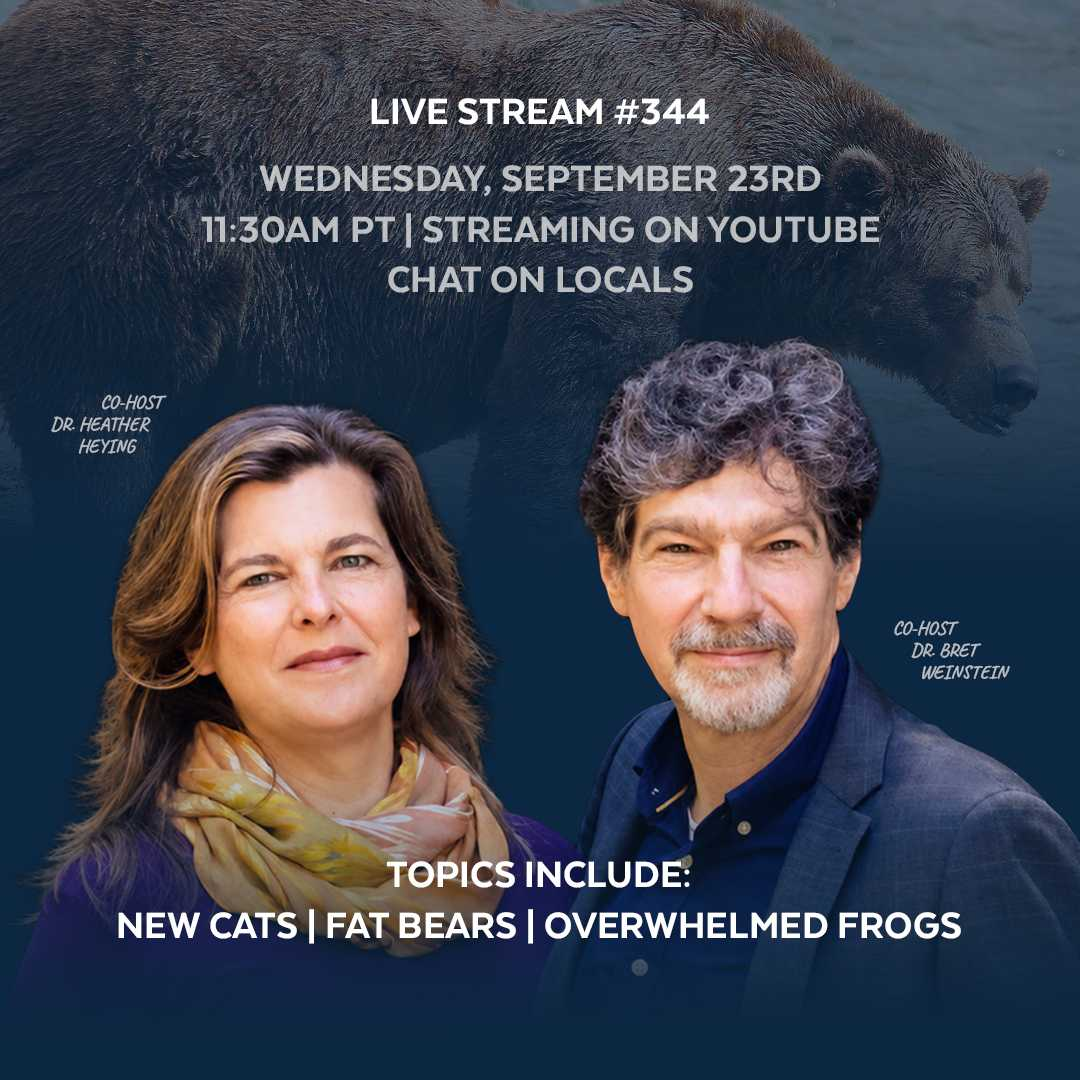
Bret Weinstein and Heather Heying will go live for Episode 344 of The Evolutionary Lens to discuss new cats, fat bears, and overwhelmed frogs.
Streaming on X, Youtube, and Rumble. Join the Watch Party here on Locals for the only place to chat while they're live at 11:30am PT.
"And so we fall again.
Summer’s exuberance gives way to decay, a slowing down, the falling of the leaves. Winter’s slumber will, in turn, cede to the springing of the leaves anew. A cycle, a circuit, a loop. We return, over and over, to the same literal place in our solar system. But we are never quite the same again."