

Lorem ipsum dolor sit amet, consectetur adipiscing elit, sed do eiusmod tempor incididunt ut labore et dolore magna aliqua. Ut enim ad minim veniam, quis nostrud exercitation ullamco laboris nisi ut aliquip ex ea commodo consequat. Duis aute irure dolor in reprehenderit in voluptate velit esse cillum dolore eu fugiat nulla pariatur. Excepteur sint occaecat cupidatat non proident, sunt in culpa qui officia deserunt mollit anim id est laborum.

DarkHorse
The DarkHorse podcast Locals community. A shared space for DarkHorse fans and DarkHorses. Subscribe to get access to exclusive live streams, the DarkHorse Discord server, and live chats for all public streams.
Interested? Want to learn more about the community?
Interested? Want to learn more about the community?
What else you may like…
Videos
Posts
Bret Weinstein and Heather Heying discuss censorship and the war in Iran:
We have "cartesian blinders being put on us so that we are trying to make sense out of scraps of information and hints." - @bretweinstein
00:02:06
Who exactly belongs in the Stone Ages?
WEINSTEIN: I mean, even if you have your villains who are engaged in the behavior that motivated this war in Iran, even if that's the story, presumably most of the people in the path of these ferocious bombings that he is describing are not deserving of going back to the Stone Age.
In fact, I distinctly remember him telling us that part of what we were up to was liberating the people of Iran from their tyrannical regime.
So if it's the tyrannical regime that justifies the ferocious bombing, then it's a tragedy that other people are going to be sent back to the Stone Ages with them. Right?
HEYING: It's it's not a narrative. It's an incoherent set of talking points.
WEINSTEIN: Yeah, it's a kind of cheerleading that is completely inappropriate from the perspective of the president.
Bret Weinstein discusses the Trump administrations "back to the stone age" recent remarks in the latest episode of The Evolutionary Lens, Episode 320 "Are we back in the stone age?" on DarkHorse.
00:00:58
Washington's 9.9% "Millionaires Tax" Isn't That Simple
Bret Weinstein explains, "If you stop businesses from starting here, and if you drive people so that they move elsewhere—even though it's difficult to do—then the point is the tax base dries up, which then forces you to become even more predatory for the people who stayed.
And that's really the thing, right? They're setting themselves up so that they have to go after more and more people, because the people who are starting new businesses are not going to do it here."
00:14:03
Tomorrow on DarkHorse Podcast
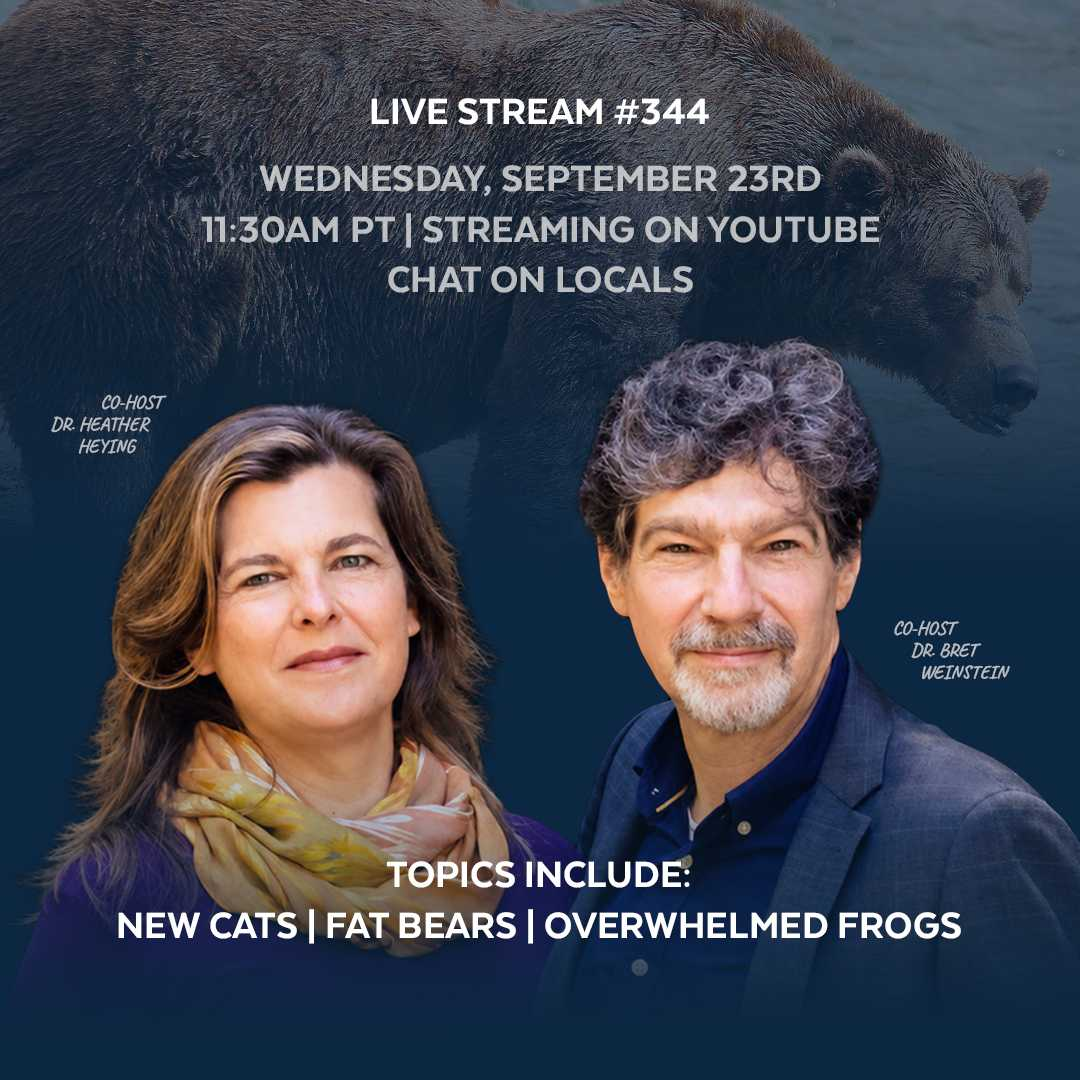
Bret Weinstein and Heather Heying will go live for Episode 344 of The Evolutionary Lens to discuss new cats, fat bears, and overwhelmed frogs.
Streaming on X, Youtube, and Rumble. Join the Watch Party here on Locals for the only place to chat while they're live at 11:30am PT.
NEW from Dr. Heather Heying on Substack - "That Time of Year"
"And so we fall again.
Summer’s exuberance gives way to decay, a slowing down, the falling of the leaves. Winter’s slumber will, in turn, cede to the springing of the leaves anew. A cycle, a circuit, a loop. We return, over and over, to the same literal place in our solar system. But we are never quite the same again."